Demo: Private Automation Hub — ClickOps vs. configuration-as-code
Start here. A customer watches a Private Automation Hub get configured twice — once by hand in the web UI, once from a file in git — and sees what the second one can do that the first cannot: show a diff, survive a re-run, and put itself back when somebody changes it.
| Length | 30 minutes (26 + 4 for questions) |
| Audience | Systems administrators and automation leads. Assumes no Private Automation Hub experience whatsoever |
| Reader | The Ansible pre-sales engineer presenting it |
| Needs a live environment? | Yes for the full version. The git diff half and every artifact are committed, so a degraded version runs offline |
| Status | Draft — screenshots captured; one rehearsal of the convergence beat before Ready |
The five documents
| File | Read it when |
|---|---|
run-sheet.md |
While presenting. Minute markers, what is on screen, exact commands, recovery moves |
talk-track.md |
While rehearsing. The narrative and the actual words, beat by beat |
clickops.md |
Before presenting. The full click-by-click for the manual half, every field value |
architecture.md |
When asked "how does that work". The three tokens, the object inventory, the timing |
objections.md |
Before you go in. What this audience asks, answered from the code |
Present from the run sheet. Rehearse from the talk track. The other three are reference.
Six files, not the template's five.
clickops.mdis a deliberate addition. The run sheet has to stay scannable by someone standing up mid-sentence, and a thirty-click UI walkthrough with every field value would swamp it.clickops.mdis reference the run sheet cites — the same relationshiparchitecture.mdalready has to it.
The 60-second version
- Open a Private Automation Hub that ships with every AAP subscription. It is empty, which is how nearly every install looks.
- Configure the
communityremote by hand in the UI. Six fields, two screens, four minutes. Then: "now do that in your other three hubs." - Ask four questions the UI cannot answer — what changed, who approved it, how do I revert, is DR the same?
- Show the same three remotes as a file in git, and the collection list as a second file. Run one playbook. Same result.
- Run it again —
changed=0. Change it in the UI and run again — it converges back. - Show what landed: 214 certified and 47 validated collections at three versions each, 15 community collections at exactly one.
What the demo is actually about is not automation and not speed. It is that a hub's contents are a supply chain, and a supply chain you cannot review is one you are trusting from memory. The re-run that silently undoes a UI change is the argument; everything else is setup.
Why it needs an environment, and what survives without one
The committed artifacts — hub/certified-requirements.yml,
hub/validated-requirements.yml, hub/community-requirements.yml, and the two
inventory/group_vars/aap/hub_collection_*.yml files — carry the whole
config-as-code half. git log and git diff over hub/ work on a plane.
What genuinely needs a cluster is the contrast: the UI dialog, the populated
repository counts, and the convergence beat. Without one, present from
architecture.md and say plainly that you are describing
rather than showing.
If you want to run it live
# Preflight, then populate. Measured 4.4 minutes on sandbox.
ansible-playbook playbooks/sync_hub.yml -i inventory --limit sandbox \
  -e target_env=sandbox \
  --vault-id sales.demos@~/secrets/.vault_pass_sales_demos
Or use the /pah-sync skill, which
runs the preflight checks first and then verifies against the hub.
Sync the day before. The demo shows a populated hub and a re-run; nobody wants to watch a cold sync.
Verified against the live sandbox
| Repository | Collections | Assertion |
|---|---|---|
rh-certified |
214 | version window applied — sampled collections carry 3 versions, not 30 |
validated |
47 | same |
community |
15 | 15/15 at exactly their pinned version and no other |
ok=56, changed=6, failed=0. All three repositories populated in 264 seconds.
Two things went wrong on the way, and both are now demo material rather than defects:
- The offline token expired mid-build (
invalid_grant: Offline user session
  not found
) — the exact quiet failure the honest-bits beat describes. - Dependency resolution failed the whole sync on a 404 for a collection in
neither list.
sync_dependenciesis now off everywhere.
Screenshots are committed (docs/images/pah-*.png) — the before and after
of the beat this demo turns on. Click either for the full-size image:
| Never synced (demo env) | Populated with approved (sandbox env) |
|---|---|
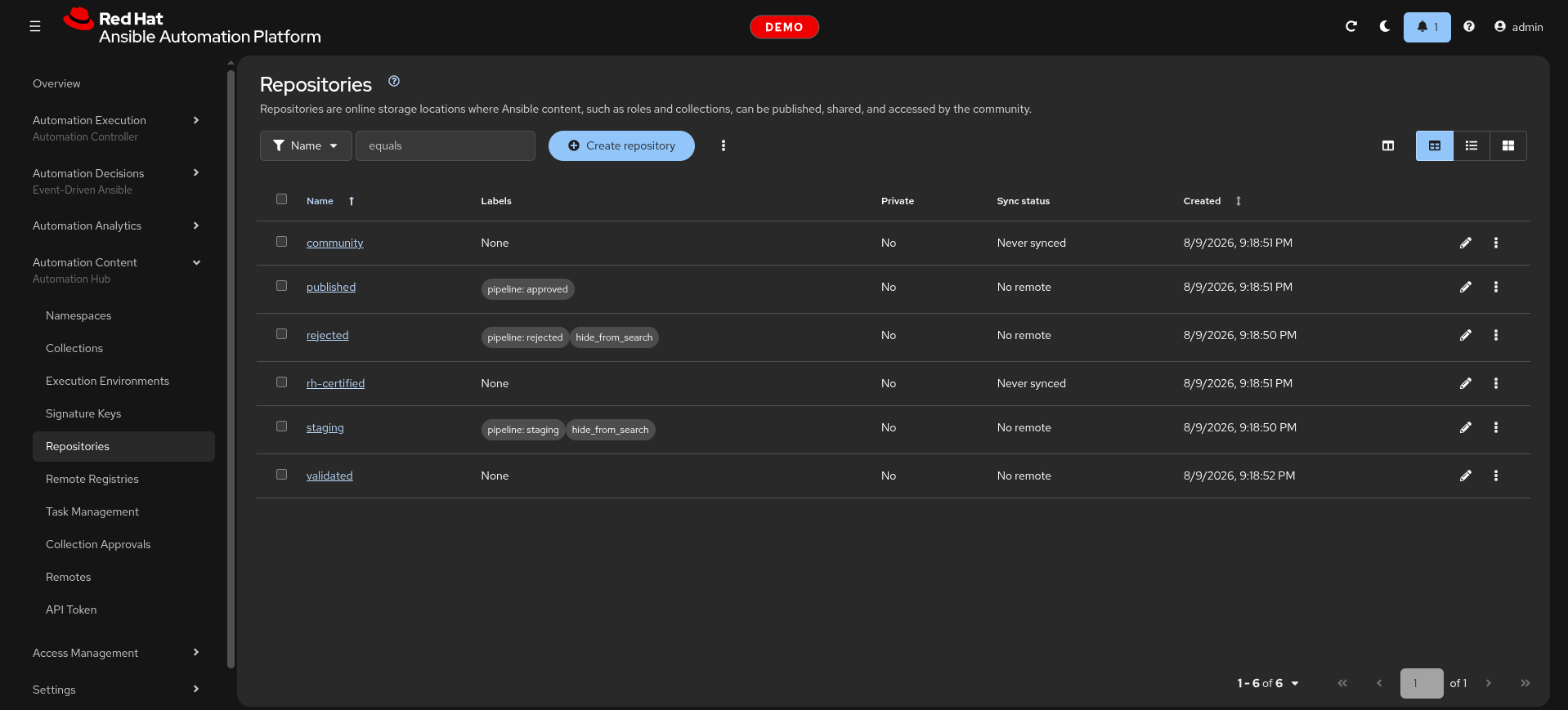 |
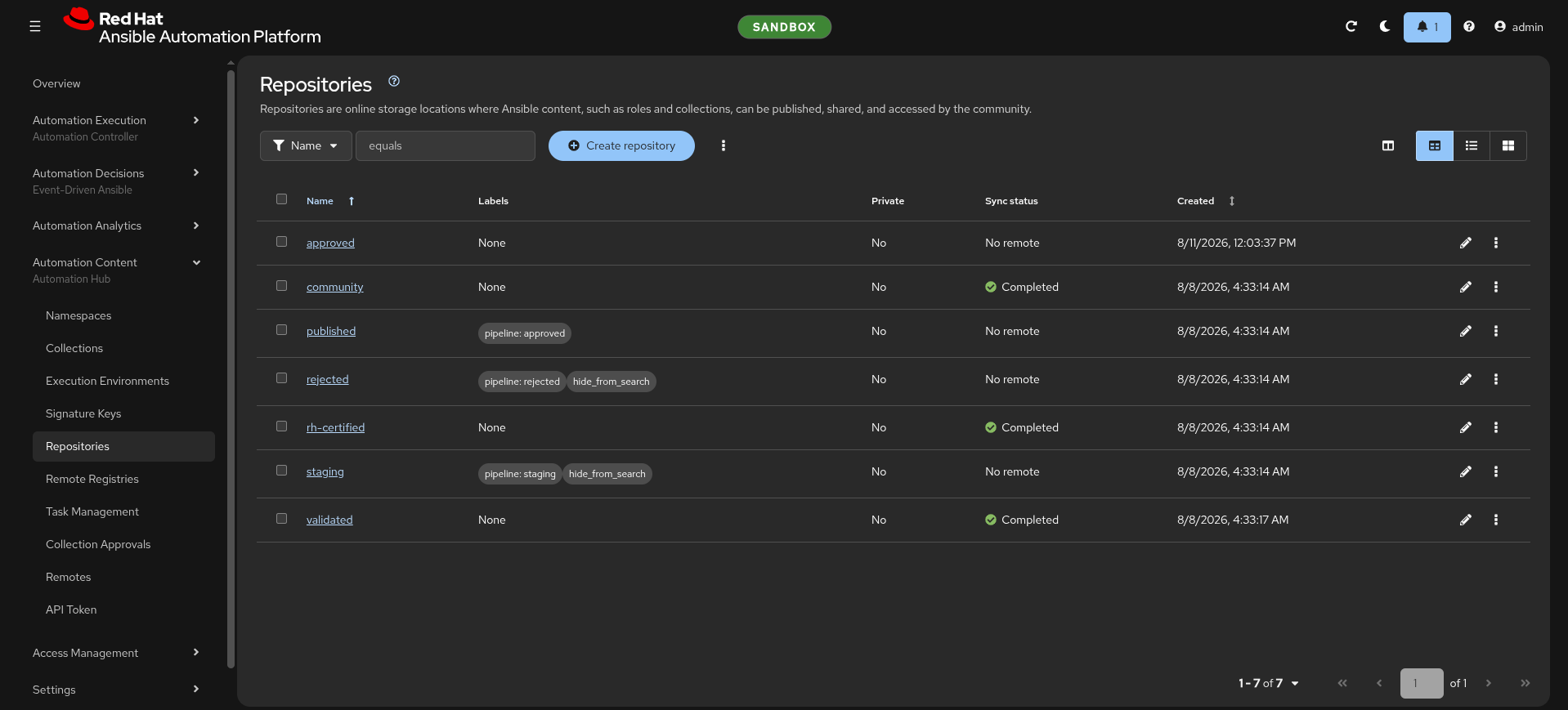 |
The three remote dialogs are in
run-sheet.md and
clickops.md.
What is still missing before this moves from Draft to Ready: one rehearsal of the convergence beat.
Related
docs/plan/pah-plan.md— why it is built this way- #68 — this use case
- #69 — pointing AAP at the hub, deliberately deferred